
Overview
My research sits broadly within cognitive science, with a particular interest in perception, attention, emotion, and how people make sense of information in complex environments. I use behavioral, psychophysiological, and mixed methods to study processes that are often difficult to observe directly, from the rapid allocation of visual attention to the way people process information under distraction, cognitive load, and uncertainty.
Across basic and applied settings, I’m interested in how the information available to us, and the limits of the cognitive system processing it, shape what we perceive, understand, remember, and ultimately do.
Cognition, Perception & Emotion
My doctoral research examined how emotional meaning shapes visual attention and language processing before information reaches the center of our gaze, and how those processes change across the adult lifespan.
Reading gave me an unusually precise way to study this. We take in more than the word we are directly looking at, extracting information from the surrounding visual field as our eyes move through text. Using a gaze-contingent boundary paradigm, I manipulated the emotional meaning of upcoming words while they were still outside direct fixation, then changed them during the reader’s eye movement. This allowed me to ask whether emotional information was already affecting processing before the reader looked directly at it.
The answer depended on age and time. Younger adults showed an early processing advantage from negative emotional information, while older adults showed a later advantage from positive information. This provided evidence that the age-related positivity effect can emerge within the moment-to-moment dynamics of visual attention and language processing, rather than only in later memory or explicit judgments.
Human Factors & Applied Cognition
My work in human factors began in David Strayer’s Applied Cognition Lab, where I studied attention and cognitive load in complex, real-world environments. Much of this work focused on driving and increasingly automated vehicles, including how older adults experience, understand, and adapt to emerging in-vehicle technologies.
One result was appropriately titled *Driven to Comment: Learning from Older Drivers’ Impressions of In-Vehicle Technologies*, a study examining older drivers’ experiences with the rapidly changing technology appearing in their vehicles.
What drew me to human factors was the premise that understanding a technology is not enough. You also have to understand the perceptual and cognitive system using it. Attention is limited, perception is selective, and those limits become consequential when we ask someone to monitor a roadway, interact with a new interface, or divide attention between competing demands.
This work gave me an applied counterpart to questions I would later pursue in my doctoral research: what information makes it through, what gets missed, and how does what we perceive shape what we do?
Applied Human Factors & Consulting
During graduate school, I worked with Hirlan, a human factors and engineering consultancy, on a neural measurement device for inpatient monitoring. I conducted usability research, analyzed experimental data using ANOVA and linear mixed-effects models, and contributed to human factors documentation supporting the device’s FDA submission.
I especially liked the client side of the work: understanding the problem they were trying to solve, working across scientific and engineering perspectives, figuring out what we could actually test, and translating the results into evidence they could use.
Methods & Measurement
My work is mixed-methods by design, spanning eye tracking, EEG/ERP, psychophysiology, behavioral experiments, quantitative modeling, surveys, usability research, and qualitative approaches.
I’m less interested in any one method than in matching the method to the question. Different measures provide different windows onto cognition, and much of the interesting work lies in understanding what each can tell us, where its limits are, and what becomes possible when different forms of evidence are considered together.
Clinical & Translational Research
Most recently, I spent a year leading clinical research at Centre for Neurology Studies in British Columbia, where I managed a team of clinical research coordinators and a portfolio spanning neuroscience, psychiatry, women’s health, and psychedelic-assisted psychotherapy. This included work with COMPASS Pathways, atai Life Sciences, Eli Lilly, and other pharmaceutical and biotechnology sponsors across Phase 1–3 clinical research.
My role sat between science, operations, and strategy. I worked with investigators, sponsors, CROs, and our research team on study feasibility and implementation, while also reporting directly to the Board and executive leadership on trial performance, revenue, and the financial health of our research portfolio. A large part of my job was taking information from very different parts of the organization and making it useful for decisions.
Science Communication & Mentorship
Science communication is one of my favorite parts of being a researcher. I love meeting an audience where they are, inviting what they already know into the conversation, and giving them enough of a foothold in the science to become genuinely curious about the questions and the data themselves.
I’ve taught at the university level and mentored undergraduate researchers through experimental design, analysis, scientific writing, and presenting their work. Some of my favorite conversations have come from putting data in front of people with different backgrounds and asking, essentially, what do you see here? A fresh perspective can change the way you think about a problem.
I’ve included a few examples of my scientific communication below. I’m also happy to share past lectures, presentation slides, or other examples of my teaching and scientific communication upon request.

Pyramidal neurons in an open field arrangement. These are type of neural populations commonly measured by EEG. Illustration by yours truly. India ink and watercolor on paper.

Conference Presentations & Invited Talks
Lopes, C.L., (2024) Rose-colored Semantics: Exploring Age Related Perceptual Changes Across the Perceptual Span. Massachusetts Institute of Technology, HELD Meeting.
Lopes, C.L., Payne, B.R., (2024) Motivated Attention in Reading: Lexical Valence Moderates Parafoveal Preview Benefits Differently in Younger and Older Adults, Evidence from Gaze-Contingent Boundary Paradigms. Psychonomic Society Annual Meeting 2024
Lopes, C.L., Payne, B.R., (2023) Investigating the Age-Related Positivity Effect in Parafoveal Word Processing During Natural Reading. Society for Affective Science Annual Meeting 2023
Lopes, C. L., Payne, B.R., (2022) Individual Differences in Verbal Working Memory and Parafoveal Word Processing During Natural Reading. Leading Edge Co-Registration Conference (NSF/Psychonomics Society).
Lopes, C.L., Payne, B.R., (2022) Understanding the time course of semantic processing across the visual field during reading: Reconciling evidence from ERPs and eye movement behavior. Society for Psychophysiological Research, 2022
Lopes, C.L., Silox, J.W., Payne, B.R., (2020) Probing Prediction Costs & Benefits: What Response Times and ERPs Reveal About the Role of Volitional Control in Context Processing. Society for Psychophysiological Research, 2020.
Silcox, J., & Lopes, C., Payne, B. (2019) The Role of the Left Inferior Frontal Cortex in Memory for Predictable and Unpredictable Words: An Event-Related rTMS Study.
Lopes, Erickson, Cooper, Wheatley, Strayer, (2019). Driven to comment: Learning from older drivers impressions of in-vehicle technologies. Proceedings of Human Factors and Ergonomics Society
University Courses Taught
Sensation and Perception (2023, 2024)
Cognitive Psychology (2021,2022,2023,2024)
Methods (2021)
General Psychology
Education
Doctorate of Philosophy, PhD, Cognitive Neuroscience, University of Utah (2022-2024) Open Science Framework (OSF) - Preregistration data and pipelines can be found at https://osf.io/s9bh6
Master of Science - MS, Cognitive Psychology, University of Utah (2019-2022)
Graduate coursework / Communication Sciences & Disorders - Speech-Language Pathology (4.0 GPA), University of Utah, College of Health - (2018)
Graduate Certificate (Professional), Usability, & Assistive Technology / Augmentative & Rehabilitation Engineering, ADA Health Policy, California State University (DH), (2015)
Bachelor of Science - B.S. Communication Sciences and Disorders, University of Idaho (2014-2016)
Bachelor of Science - B.S. Medical Anthropology (minor in Bioethics), San Francisco State University (2009-2012)


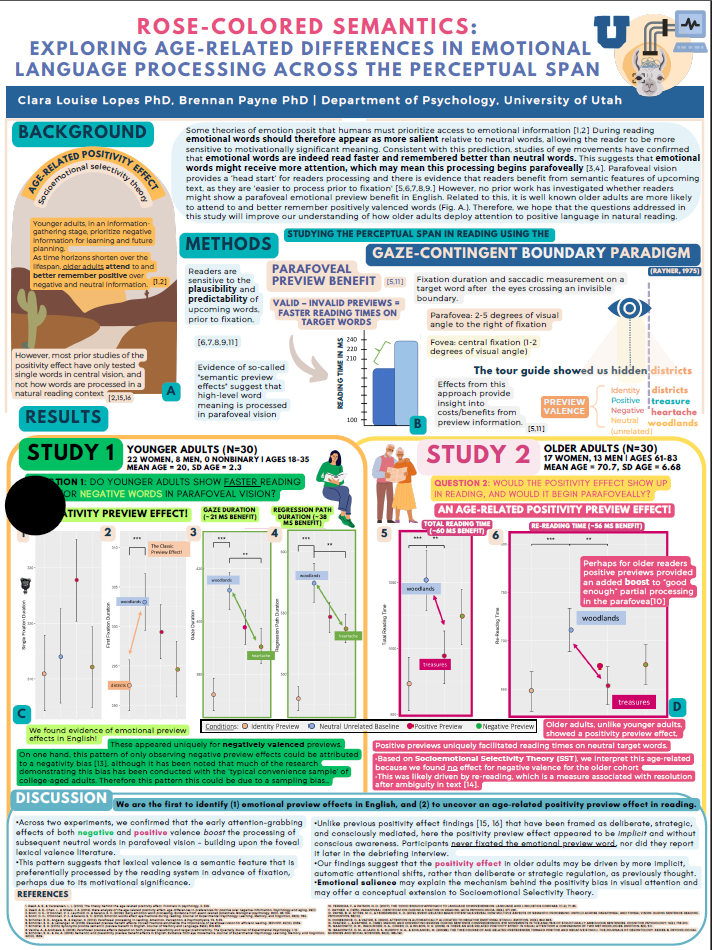
Psychonomics presentation, 2024.

Society for Psychophys Research (SPR) 2023
Prediction Violations in the Brain - Society for Psychophysiological Research (SPR) Conference - 2020